
Veronika Geng wins the Ronny Pieters Award
Nurse scientist Ms. Veronika Geng (DE) has won the prestigious Ronny Pieters Award for her contributions to European urological nursing education. The award was presented at the EAUN Annual Nurses’ Dinner, recognising her 40+ years in nursing research and education.
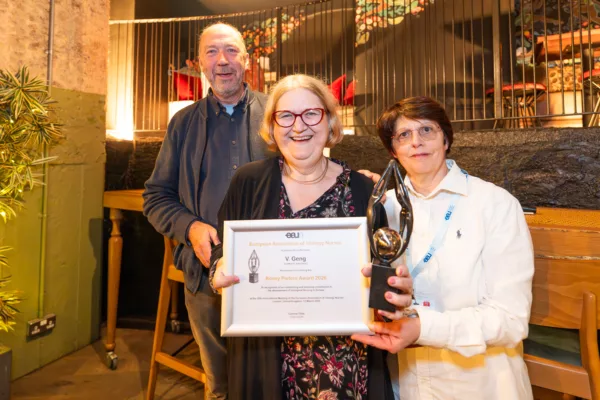
Ms. Geng specialises in neuro-urology. She is a registered nurse, infection control practitioner, and coach for quality in health care, holding a Master of Health Science. She leads an advice centre for people with spinal cord injuries (SCIs) at the Manfred Sauer Foundation in Lobbach, Germany. Her clinical research includes studies on the incidence of hospital-acquired UTIs, and her special interests are bladder and bowel management in SCI, as well as nutrition.
Chair and Co-chair of EAUN SIG Continence Ms. Therese Kelly (IE) and Ms. Eva Wallace (IE) said: “Nursing is an art and a science. Science explains the work of a nurse and art addresses the human connections. Ms. Geng is an exemplary example who epitomises both with her technical skills, unwavering commitment, compassionate approach & empathy. Sharing knowledge, consideration, kindness, and courage while shaping the future of continence nursing, she is a highly respected leader and role model for us all.”
Contributions to the EAUN
Ms. Geng served on the EAUN Board from 2007 to 2012 and has been involved with other specialised groups since then, in which she has worked tirelessly to advance the profession of urological nursing through clinical expertise, education, research and international collaboration. This includes contributing to policy protocol & guidelines, and notably, producing instructional videotapes on the male external catheter and intermittent catheterisation. Ms. Geng has delivered lectures, workshops/hands-on training sessions, masterclasses across Europe and internationally, including the United Arab Emirates.
Nursing Guidelines
Ms. Geng has contributed as Chair or member to several guidelines’ panels, and is the co-author to numerous guidelines including:
- EAUN Guideline for Urethral intermittent catheterisation in adults – including urethral intermittent dilatation
- EAUN Guideline for Indwelling catheterisation in adults – urethral and suprapubic
- EAUN Guideline for Male external catheters in adults – urinary catheter management
- Guideline for the Management of neurogenic bowel dysfunction in spinal cord injury/disease
Extensive research
Ms. Geng has published numerous scientific papers over the years, focusing on neurogenic bladder and bowel dysfunction in people with SCI. Her bowel-focused research covers nutrition, digestion, conservative and invasive treatments, trans-anal irrigation, and long-term bowel management. Other work she has published examines rehabilitation outcomes, use of assistive devices, outpatient therapy, participation in working life, and health-care provision in Germany, providing evidence to improve clinical practice and care pathways.
Author of books in German and English
Ms. Geng has co-authored two books on paraplegia, covering the anatomy, physiology, pathophysiology, and living with SCI. She has also co-authored books on nutrition and bowel management for SCI, as well as a cooking book for people with SCI and quality management in health care.
Exclusive interview with Ms. Geng
What does winning the Ronny Pieters Award this year mean to you?
Ms. Geng: “I am delighted and deeply touched to receive this wonderful award. I would like to express my sincere gratitude to the EAUN for recognising my work in this way. I feel proud and honoured. It would never have occurred to me that I could receive such an award.”
“The Ronny Pieters Award is especially meaningful to me for two reasons: Firstly, I see this award as the culmination of my 40 years in various roles devoted to people with SCIs, in which bowel and bladder function have always played a central role. If a person with a SCI were allowed to make three wishes to a fairy, he or she would still be sitting in a wheelchair. The issues of bladder, bowel and sexuality have more influence on quality of life than not being able to walk.”
“Secondly, this award further strengthens my motivation for our work and comes at a time in my life that I would describe as a time of change – a time of transition: a generational change is imminent. It is time to focus on succession, in the spirit of sustainability, to protect what has been achieved and ensure it is preserved beyond my own finite commitment. It is important to find successors and support them in the best way possible, so that they can effectively continue the work in the future and carry forward their passion for continence. This takes time and resources – I am committed to making it happen.”
Where did your interest in a career in urology come from?
“During my basic training as a nurse, my passion was to become a surgical nurse. Ending up in SCI care was more of a coincidence. Out of curiosity, I trained as a hygiene specialist, where I noticed that people with SCIs often suffer from UTIs, which can affect the intestines and cause many problems.”
“For example, at the end of the 1980s, smelly latex urinals were replaced by disposable urine bags. And at the beginning of the 1990s, there was a first project on the subject of catheterisation, where I was able to use the practical aspects of nursing with my knowledge as an infection control practitioner. Later, quality assurance was added. When you deal with a topic so intensively, you become an expert, and being sought after as an expert confirms that you are doing things well and can contribute meaningfully. That's how I became involved with the EAUN, with the request to support the first guideline on intermittent catheterisation. I found it exciting to exchange ideas with European nurses, to discuss and to learn from each other.”
Who has supported you through your career?
“First, I must mention my parents, because they taught me from an early age that if you can't do something, then you should learn and practise it. That's still how it is today – if I can't do something, I keep trying. I’ve also been truly fortunate to have had bosses who supported me and gave me a great deal of freedom. They believed in me.”
What’s on your urology bucket list still?
“I think there is still room for much improvement. We have developed guidelines, but these must also be applied. There is still a great deal that can be done to further develop e-learning. There are new techniques, such as wearable devices for bladder volume, and we need to see how these function and whether they can improve quality of live for people with neurogenic dysfunction. From a political perspective, I would also like to use my time until retirement to further improve accessibility to neuro-urology and primary care for people with SCI.”