
3. TERMINOLOGY
A catheter is a thin hollow flexible tube that can be inserted in the bladder either through the urethra (urethral) or suprapubic to drain the urine or other bladder contents.
3.1 Transurethral or suprapubic catheterisation
Transurethral indwelling catheterisation or urinary catheterisation is defined as passage of a catheter into the urinary bladder via the urethra (urethral catheter) [5] (Figs. 1 and 2). Transurethral indwelling catheterisation is also called urethral catheterisation. In this document, we only use the term urethral catheterisation.
Suprapubic catheterisation is the insertion of a catheter into the bladder via the anterior abdominal wall (Figs. 3 and 4).
Urethral catheterisation
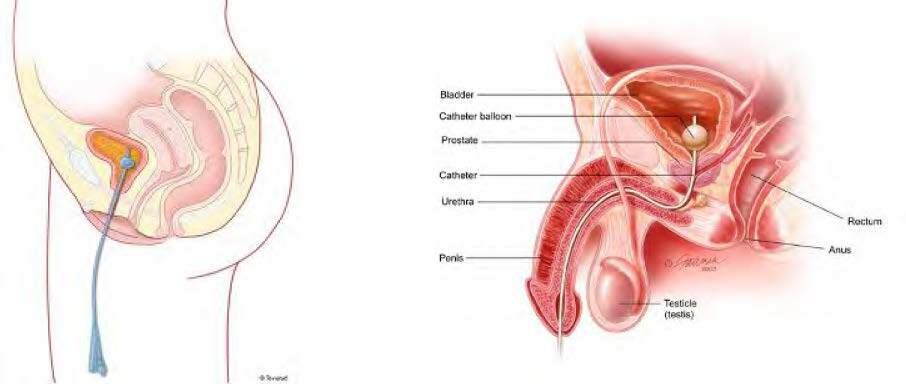
Left: Fig. 1 Urethral catheter in female
(Courtesy of Coloplast A./S, see chapter 15)
Right: Fig. 2 Urethral catheter in male
(Courtesy of: Urologyhealth.org, see chapter 15)
Suprapubic catheterisation
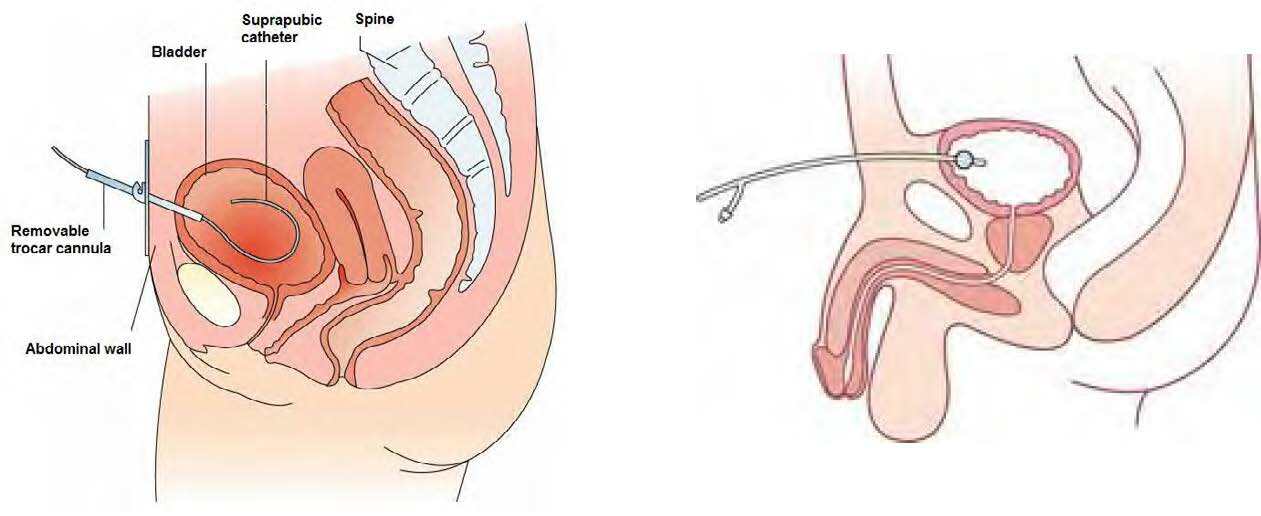
Left: Fig. 3 Suprapubic catheter
(Courtesy of: Hospital Santa Maria Lleida)
Right: Fig. 4 Suprapubic catheter with balloon
(Courtesy of Coloplast A./S, see chapter 15)
3.2 Short-term or long-term catheterisation
Short-term or long-term catheterisation depends on the indication. Short-term catheterisation is defined as a duration of catheterisation which is intended to be < 14 days. [6]
Accordingly, long-term catheters remain in situ for ≥ 14 days, usually because of urinary retention secondary to disease conditions. [6-9]
3.3 Closed drainage system
A closed catheter drainage system is an aseptic system in which the path from the tip of the catheter inserted into the bladder, to the bag which catches urine, is closed and should not be disconnected. This is intended to eliminate inoculation of the urinary tract with bacteria via the catheter drainage tubing and from the collection bag. [10]
The term closed drainage is, however, not strictly accurate as there are numerous portals of entry for pathogens and the system must be opened to allow emptying and be disconnected when the drainage bag is changed.